Introduction
In an era defined by global economic competition and shifting geopolitical alliances, connectivity has become one of the most important sources of strategic power. Nations that successfully position themselves as trade and transportation corridors gain not only economic advantages, but also political influence and long-term stability.
For Iraq, this reality presents a historic opportunity.
The country’s ambitious “Development Road” project, combined with China’s Belt and Road Initiative (BRI), could transform Iraq from a conflict-affected state into a central logistical and commercial hub linking Asia, the Middle East, and Europe.Although some geopolitical observers portray these projects as competing initiatives, a deeper strategic analysis suggests the opposite: the Development Road and the Belt and Road Initiative are potentially complementary frameworks capable of creating economic synergy, regional integration, and shared prosperity.This report examines how the integration of these two mega-projects could reshape Iraq’s economic future and contribute to regional peace through interdependence and connectivity.
Iraq’s Development Road: A Strategic Vision
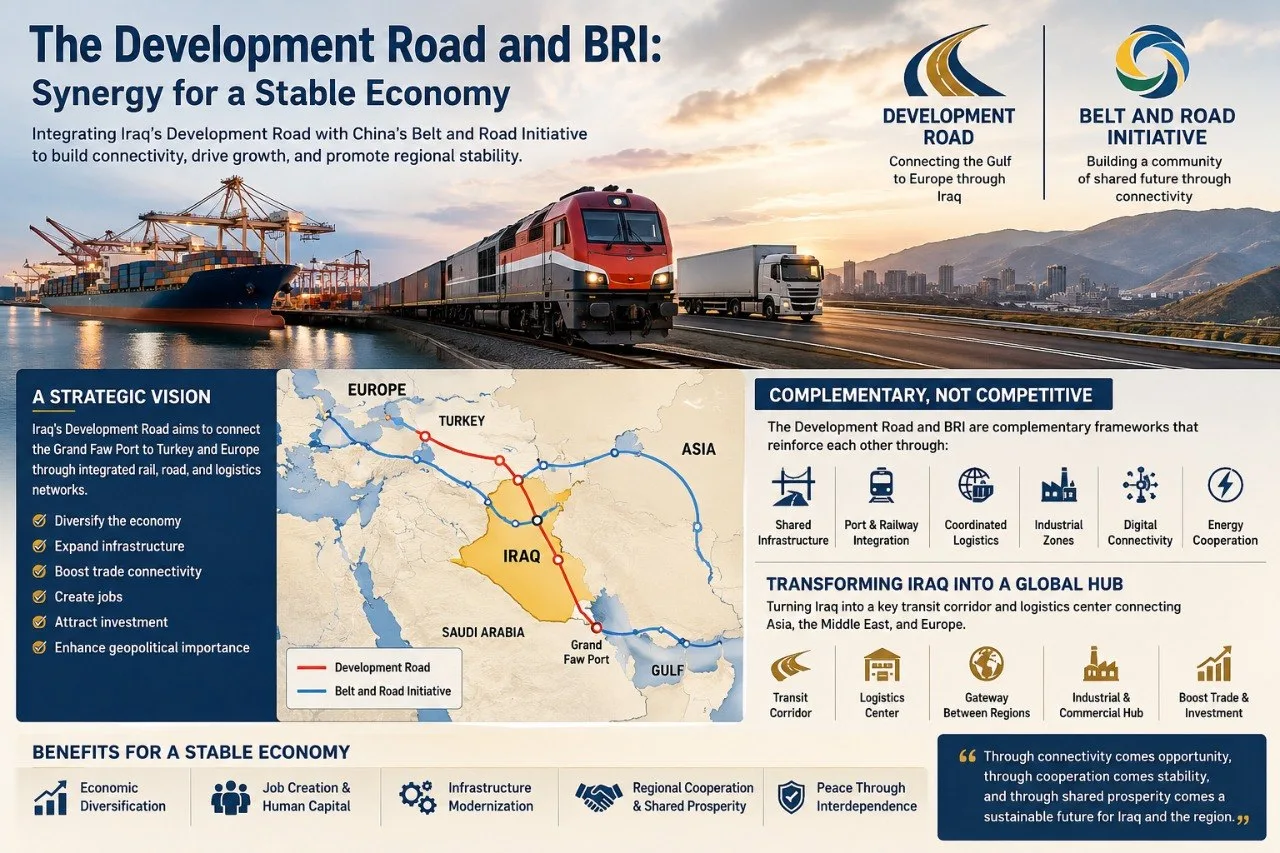
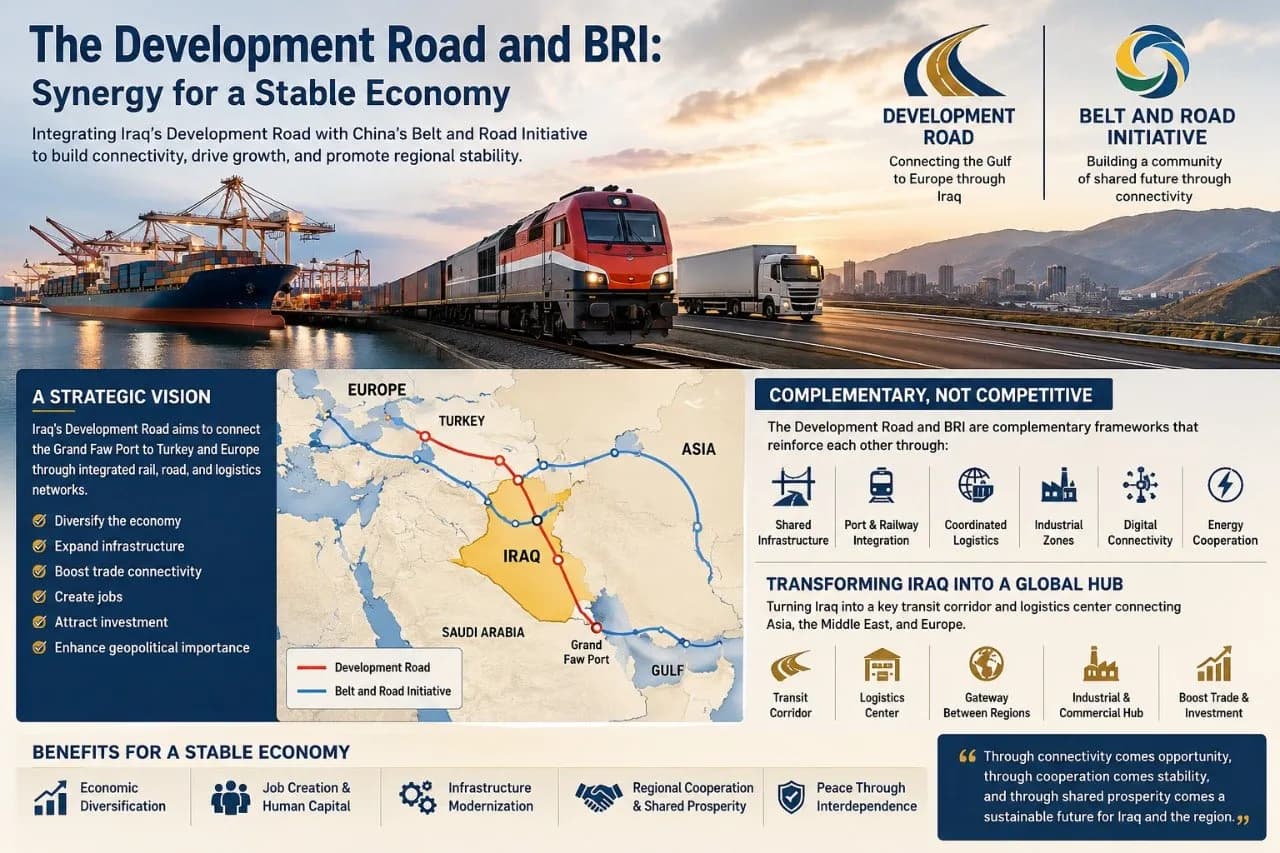
The Development Road project is one of Iraq’s most ambitious economic strategies in decades. The initiative aims to connect the Grand Faw Port in southern Iraq with Turkey and Europe through an extensive network of railways, highways, and logistical infrastructure.The project seeks to position Iraq as a major transit corridor for global trade moving between Asia and Europe.
Its core objectives include:
* Diversifying Iraq’s economy beyond oil
* Expanding transportation infrastructure
* Increasing regional trade connectivity
* Creating employment opportunities
* Attracting foreign investment
* Strengthening Iraq’s geopolitical importance
Given Iraq’s geographic location, the Development Road could become a strategic bridge linking the Gulf region with European markets.
The Belt and Road Initiative: Global Connectivity
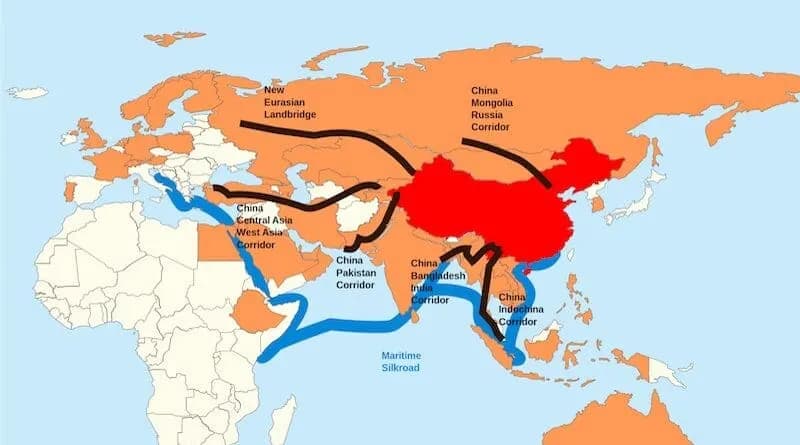
China’s Belt and Road Initiative represents one of the largest international infrastructure and connectivity projects in modern history. Led by Xi Jinping, the initiative focuses on strengthening trade routes, transportation networks, digital connectivity, and economic cooperation across Asia, Africa, Europe, and the Middle East.
The BRI includes investments in:
* Ports and maritime corridors
* Railways and highways
* Energy infrastructure
* Digital connectivity
* Industrial cooperation
* Trade and logistics hubs
For China, the initiative supports long-term trade security and economic integration. For participating countries, it offers opportunities for infrastructure development, investment, and international connectivity.Iraq occupies an especially important geographic position within this broader regional network.
Complementary, Not Competitive
Some international analysts interpret Iraq’s Development Road as an alternative to the Belt and Road Initiative. However, this perspective oversimplifies the strategic realities of modern connectivity.
In practice, the two projects can reinforce one another.
The Development Road provides Iraq with a north-south transportation corridor connecting Gulf trade routes to Turkey and Europe. Meanwhile, the Belt and Road Initiative offers broader international logistical integration linking Asian production centers with global markets.
Rather than operating separately, these frameworks can intersect through:
* Shared transportation infrastructure
* Port and railway integration
* Coordinated trade logistics
* Industrial investment zones
* Digital trade connectivity
* Energy cooperation
This synergy could significantly enhance Iraq’s economic relevance in regional and global trade systems.
Iraq as a Global Logistical Hub
Historically, Iraq occupied a central position along ancient trade routes connecting East and West. Today, modern infrastructure and international cooperation could revive that historical role in a new economic form.If successfully implemented, the integration of the Development Road with BRI networks could transform Iraq into:
* A transit corridor for international trade
* A regional logistics center
* A transportation and warehousing hub
* A gateway between the Gulf and Europe
* A center for industrial and commercial investment
The strategic importance of the Grand Faw Port is particularly significant. Positioned near the Gulf, the port could become one of the region’s most important commercial gateways if connected efficiently to railway and road systems extending northward.
Such development would reduce transportation times, improve regional trade efficiency, and increase Iraq’s economic influence.
Economic Diversification and Stability
For decades, Iraq’s economy has depended heavily on oil revenues, leaving the country vulnerable to fluctuations in global energy prices.The Development Road and BRI partnership could support broader economic diversification through:
* Trade expansion
* Industrial growth
* Transportation services
* Logistics and warehousing industries
* Technology and telecommunications development
* Tourism and commercial activity
Large infrastructure projects also generate employment opportunities across engineering, transportation, construction, and services sectors.More importantly, diversified economies tend to be more resilient and politically stable than economies dependent on a single resource sector.
Regional Connectivity and Shared Prosperity
One of the most important dimensions of modern economic diplomacy is the concept of interdependence.Countries connected through trade, infrastructure, and shared economic interests are often more motivated to maintain stability and cooperation.The integration of Iraq’s Development Road with the Belt and Road Initiative could strengthen economic relationships between:
* Iraq
* China
* Turkey
* Gulf countries
* Central Asia
* Europe
This network of connectivity may contribute to reducing regional tensions by increasing mutual economic interests.Infrastructure therefore becomes more than a transportation system—it becomes a mechanism for regional cooperation and peace-building.
The Kurdistan Region and Strategic Connectivity
The Kurdistan Region could also play an important role within this emerging logistical landscape.Due to its geographic location between Iraq and Turkey, the region possesses strategic advantages in transportation, trade, and investment connectivity.
Improved infrastructure could stimulate:
* Cross-border commerce
* Industrial development
* Tourism expansion
* Digital connectivity
* Private-sector investment
For Kurdish youth and entrepreneurs, regional integration may create new opportunities in logistics, technology, media, and international business.The region’s relative stability also increases its attractiveness for investment and commercial partnerships.
Geopolitical Dimensions
The strategic importance of Iraq’s Development Road extends beyond economics.Global powers increasingly compete over trade corridors, transportation routes, and infrastructure influence. Iraq’s geographic position makes it a key player in this evolving geopolitical environment.However, Iraq faces an important challenge: balancing international partnerships while protecting national sovereignty and strategic independence.Successful implementation of the Development Road will require:
* Diplomatic balance
* Transparent governance
* Regional cooperation
* Security stability
* Long-term economic planning
The country’s ability to maintain constructive relations with multiple global actors will shape the future success of the project.
Challenges Facing Integration
Despite the enormous potential, several obstacles remain.
- Security Concerns
Political instability and regional tensions continue to affect investor confidence.
- Infrastructure Gaps
Large-scale transportation systems require long-term maintenance and modernization.
- Bureaucratic Challenges
Administrative inefficiency and corruption may slow implementation.
- Geopolitical Competition
International rivalries may complicate cooperation between different regional actors.
- Economic Sustainability
Projects must produce sustainable economic returns rather than symbolic infrastructure alone.Addressing these issues will determine whether Iraq can fully realize its logistical potential.
Connectivity as a Path Toward Peace
Historically, many regions achieved stability through economic integration rather than military confrontation.Europe’s post-World War II reconstruction demonstrated how trade and economic cooperation could reduce conflict between states previously divided by war.Similarly, regional connectivity projects in the Middle East may help create stronger incentives for cooperation and coexistence.The Development Road and the Belt and Road Initiative offer a framework in which economic interests become linked across borders. In this model, prosperity depends on collaboration rather than confrontation.This vision does not eliminate political differences, but it can reduce the economic motivations for instability.The relationship between Iraq’s Development Road and China’s Belt and Road Initiative should not be viewed through the lens of competition alone. Instead, these projects possess significant potential for strategic synergy.Together, they could transform Iraq into a major logistical and economic hub connecting Asia, the Gulf, and Europe. More importantly, they offer Iraq an opportunity to diversify its economy, strengthen regional connectivity, and reposition itself within global trade networks.The integration of these initiatives also reflects a broader shift in international politics—one where infrastructure, trade, and connectivity increasingly shape geopolitical influence.For Iraq, success will depend not only on constructing roads and railways, but also on building stable institutions, effective governance, and long-term regional cooperation.If managed wisely, the Development Road and the Belt and Road Initiative may become more than infrastructure projects. They could form the foundation of a more interconnected, stable, and prosperous Middle East.
References:
- Belt and Road News Network
[BRNN Official Website](https://en.brnn.com?utm_source=chatgpt.com)
- People's Daily
[People's Daily Online](https://english.people.com.cn?utm_source=chatgpt.com)
- World Bank
[World Bank Iraq Overview](https://www.worldbank.org/en/country/iraq?utm_source=chatgpt.com)
- Asian Infrastructure Investment Bank
[AIIB Official Website](https://www.aiib.org?utm_source=chatgpt.com)
- Ministry of Transport of Iraq
[Iraqi Ministry of Transport](https://mot.gov.iq?utm_source=chatgpt.com)
- China Global Television Network
[CGTN Official Website](https://www.cgtn.com?utm_source=chatgpt.com)
- Center for Strategic and International Studies
[CSIS China Power Project](https://chinapower.csis.org?utm_source=chatgpt.com)
- “The Development Road and BRI: Synergy for a Stable Economy” by Halo Hassan Saeed