In the hills of northern Iraq, a new highway is quietly dismantling the logic of conflict — one job, one truck, one trade route at a time.
By Halwest Hassan
ERBIL, IRAQI KURDISTAN
They do not share a language. The Chinese construction manager holds a rolled blueprint; the Kurdish foreman traces the contour lines with a calloused finger. Neither needs to speak. In the rugged hills of northern Iraq — not far from the crumbling arches of an ancient Silk Road caravanserai — both men understand the same calculation: a road that stays open means reliable salaries, paid school fees, and one less reason to pull a trigger.
This is not a story about concrete or asphalt. It is a story about choice — and how the revival of the world’s oldest trade network is quietly transforming the logic of the Middle East’s most conflict-weary region.
| 150+
BRI Partner Nations |
|
$213.5B
Chinese BRI Investment (2025) |
|
1M Jobs
Projected Corridor Employment |
Beneath the Headlines, a Different Story
For decades, the international gaze has fixed on the Middle East through a narrow aperture: armed conflict, geopolitical rivalry, economic fragility. That framing, while not inaccurate, is dangerously incomplete. Beneath the noise of headlines, a far quieter revolution is underway — one measured not in casualties, but in kilometers of highway, megawatts of electricity, and the first Wi-Fi signal to reach a village in the Zagros foothills.
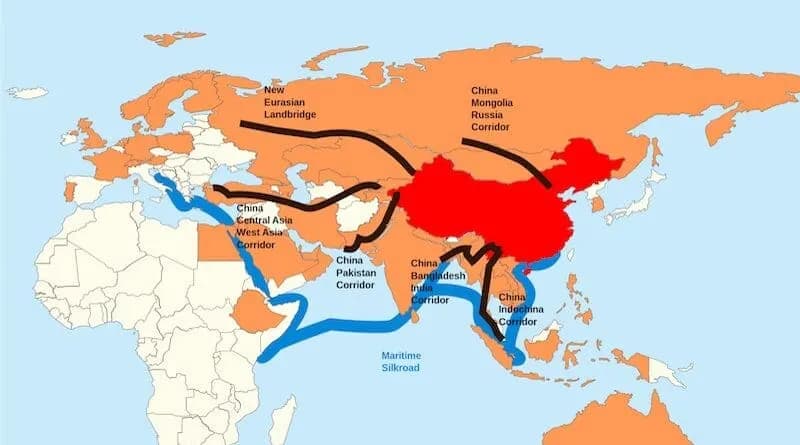
Since its launch in 2013, China’s Belt and Road Initiative has grown to encompass more than 150 nations representing nearly 40% of global GDP. By 2025, total Chinese economic engagement across BRI partner countries reached $213.5 billion. The figures are staggering. But the most significant impact of the initiative is something the spreadsheets cannot fully capture: the expansion of human choice.
| “True connectivity expands optionality — granting sovereign nations, local businesses, and everyday people viable alternatives where once there were only constraints.”
— Corridors of Coexistence, 2025 |
A Nation Rewrites Its Geography
At the fulcrum of this regional realignment sits Iraq — a country that has spent much of the past two decades defined by what it has lost. Now, it is betting $17 billion on what it might become.
The Development Road Project is an audacious 1,200-kilometer corridor designed to connect the Grand Faw Port on the Persian Gulf directly to the Turkish border, and from there onward to European markets. It is, in the most literal sense, Iraq’s attempt to insert itself back into the map of global commerce — to transform from a battlefield into a bridge.
The projected returns are transformative: 100,000 jobs in the initial phase, scaling toward one million long-term, with an estimated $150 billion in foreign and domestic investment unlocked along the corridor’s length. For a country where youth unemployment has historically fueled insurgency, these numbers carry weight far beyond the economic.
- ROADS AS PEACE INFRASTRUCTURE
Every Job Is an Argument Against Extremism
In post-conflict societies, infrastructure is never merely infrastructure. A paved road is an argument. A functioning power grid is a political statement. A young man with a salary and a phone contract has a stake in the stability of the system that pays him — and therefore a reason to protect it.
The evidence on the ground supports this logic. Trade corridors linking the Kurdistan Region to federal Iraq have deepened economic interdependence between communities that spent much of the 1990s in open conflict. Digital networks now connect remote mountain villages to urban markets, creating micro-economies that did not exist a decade ago.
“When communities are tethered to mutual economic survival,” one Kurdish economic official told this reporter, “the cost of disruption becomes too high for anyone to bear.” Pragmatism, it turns out, is a more durable peace treaty than any document signed in a distant capital.
| “Pragmatism on the ground consistently outruns rigid ideology.”
— Field observation, Erbil, 2025 |
A Partner Who Asks Only About Oil — and Infrastructure
China’s approach to Iraq has been, by design, deliberately transactional — and that transactionalism is precisely its diplomatic advantage. Beijing does not offer lectures on governance or conditions tied to political reform. It offers contracts.
Importing roughly one million barrels of Iraqi crude oil daily, China has become Iraq’s largest trading partner. The landmark 2019 “oil-for-reconstruction” framework took that relationship further, channeling petrodollars directly into ports, power plants, and industrial zones — infrastructure that diversifies Iraq’s economy beyond the single vulnerability of oil exports.
Critics argue this model risks recreating dependencies of a different kind. Proponents counter that in a region where foreign engagement has historically arrived with soldiers and ideological conditions attached, a partner who asks only about logistics is a genuinely novel proposition.
Connectivity as the Antidote to Isolation
Back on the hillside outside Erbil, the blueprint has been rolled up. The Chinese manager and the Kurdish foreman are walking the proposed route, boots on gravel, pointing at elevations. Work begins next month.
The success of this project — and of the BRI in Iraq more broadly — will not ultimately be measured in miles of asphalt or the dimensions of a port. It will be measured in the options it creates: for the young engineer who no longer needs to emigrate; for the trader who now has three markets instead of one; for the family in a border village whose lights now stay on past sunset.
The most powerful road, it turns out, is never the one that connects two cities. It is the one that gives a people the power to choose their own direction forward.