China As It Is | Beijing
Introduction
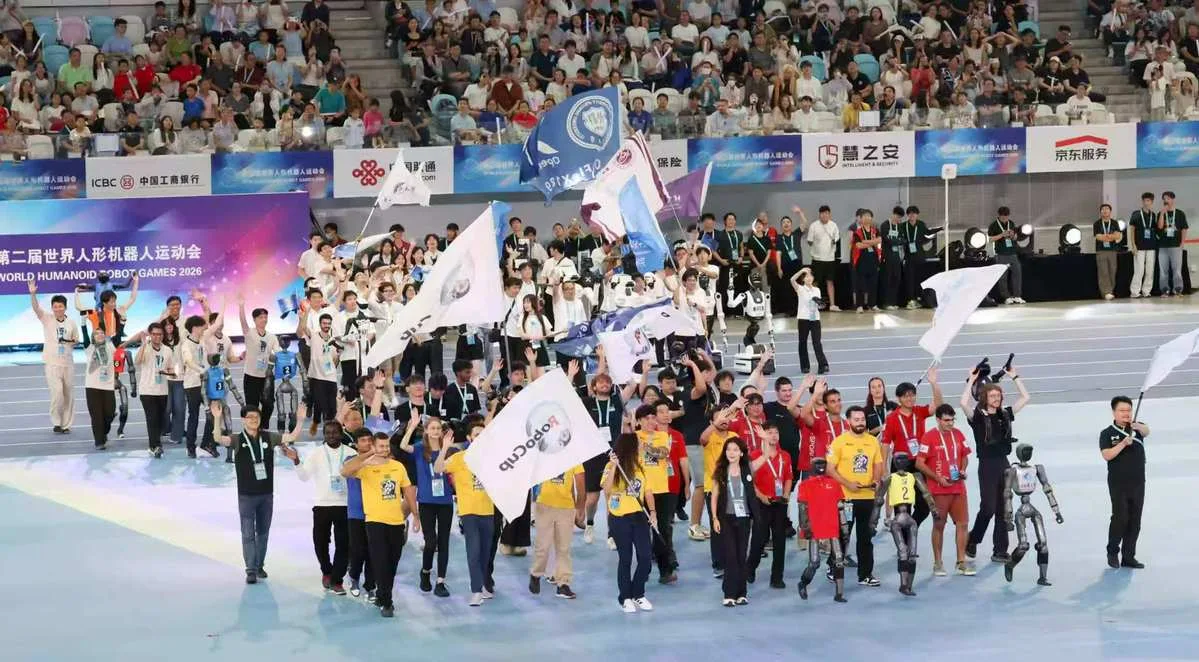
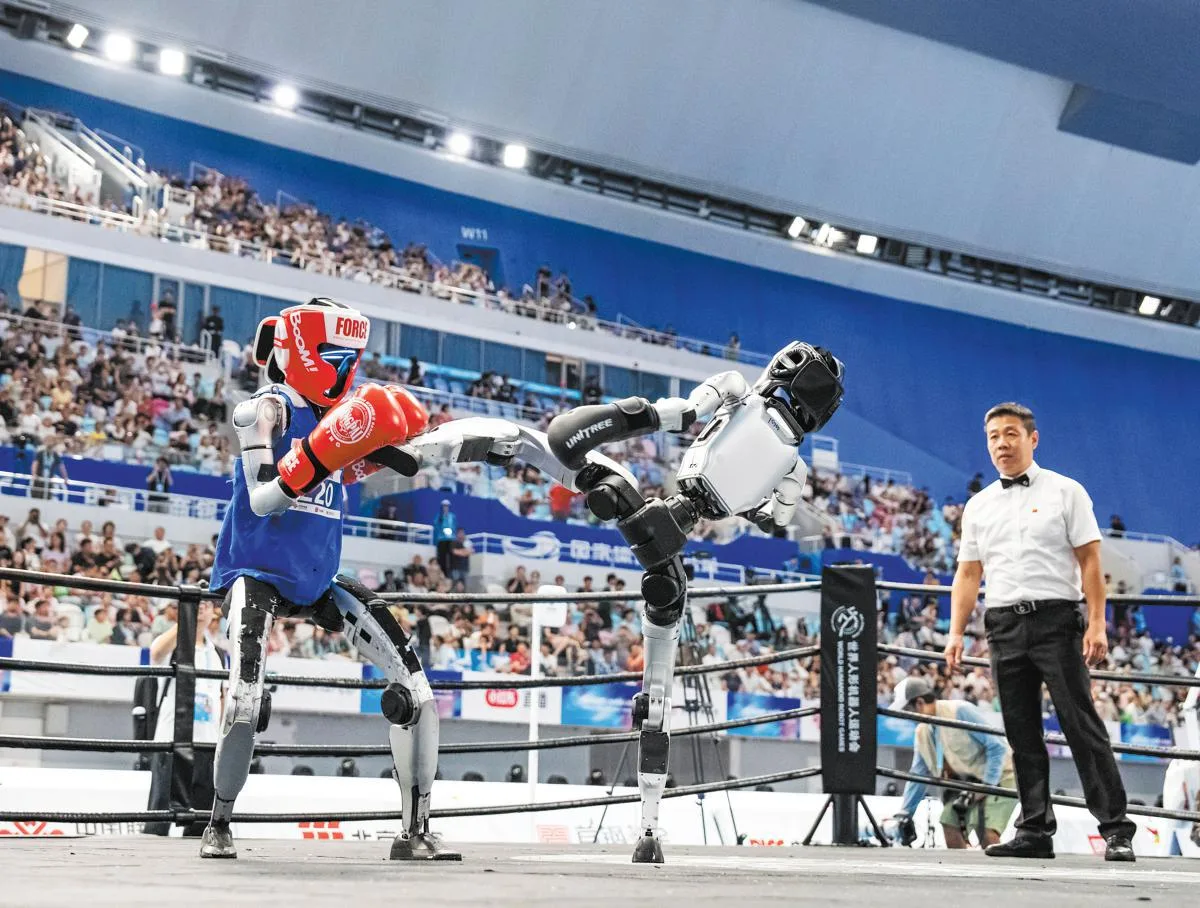
The second World Humanoid Robot Games in Beijing are offering a striking demonstration of how quickly humanoid robotics is advancing, with more than 2,000 robots competing across a range of sporting disciplines and new records highlighting the rapid improvement in robotic performance.
Held at the National Speed Skating Oval, known as the “Ice Ribbon,” the Games have brought together 666 teams from 16 countries across six continents, according to information shared by the China Broadcasting International Cooperation Economic & Technical Co. (CBIC).
The scale of the event has expanded dramatically compared with its inaugural edition. The number of participating teams has increased by 138 percent, while the number of robots has quadrupled, reflecting growing international interest in humanoid robotics and the accelerating development of the industry.
Robots Push the Limits of Athletic Performance
Some of the most remarkable moments have come from the track and field competitions.
In the 100-meter sprint, a robot representing the Tianzhuo team recorded a time of 9.39 seconds, according to the event information. That time is faster than the 9.58-second human world record associated with Usain Bolt.
The improvement is particularly striking when compared with last year's best robotic time of 21.50 seconds, illustrating how rapidly robotic locomotion and control systems are developing.
The progress is equally dramatic in jumping events. A Tianxiao robot cleared 2.88 meters in the standing high jump, compared with the winning height of 95.6 centimeters at last year's Games.
In the long jump, competitors have already exceeded 7 meters, compared with just 1.25 meters in the previous edition.
These performances demonstrate advances not only in mechanical power but also in balance, motion planning, sensing and real-time control—technologies that are fundamental to the wider development of humanoid robots.
Football Tests Multi-Robot Coordination
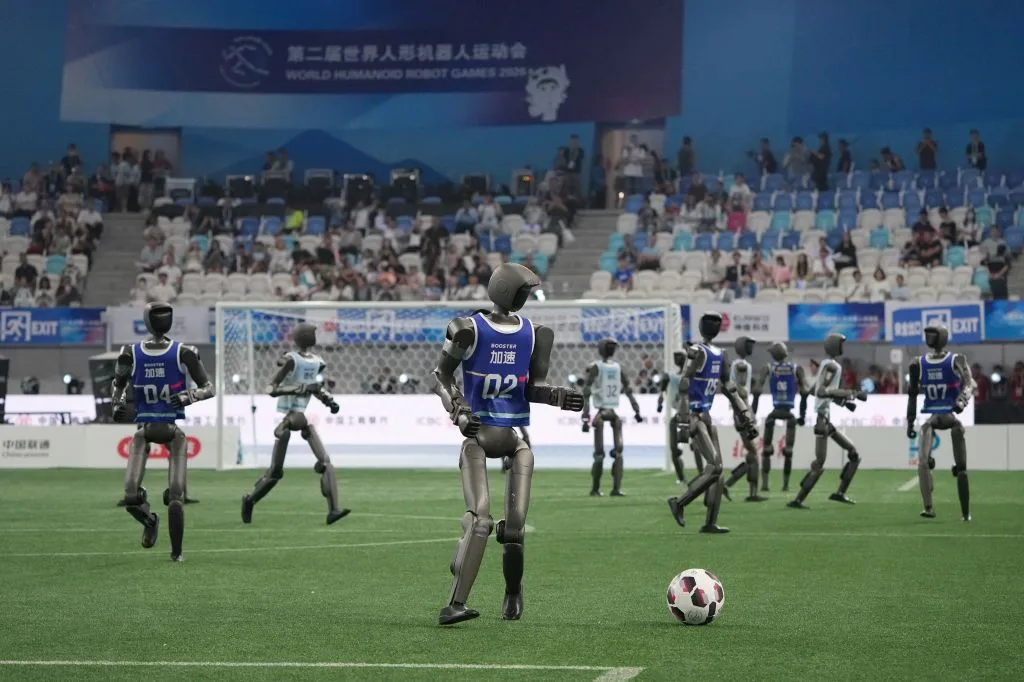
Football has also become an important test of robotic intelligence.
This year's competition has been upgraded from 3-versus-3 to 5-versus-5, creating a more complex environment in which robots must coordinate with teammates while processing visual information, identifying positions and responding to changing situations on the pitch.
Unlike individual athletic events, team football requires multiple robots to interact within a shared environment. This makes it a useful demonstration of technologies including visual perception, spatial positioning, autonomous decision-making and multi-robot coordination.
Other competitions scheduled during the Games include weightlifting, pitch-pot and tug-of-war, which are designed to test the dexterity, manipulation and physical capabilities of humanoid robots.
China’s Manufacturing Ecosystem Supports Rapid Expansion
Behind the sporting spectacle is a broader industrial transformation.
According to the 2026 Humanoid Robot Industry Development Report, released on August 20, China's humanoid robot shipments exceeded 40,000 units in the first half of 2026, accounting for 97 percent of global shipments, according to figures shared by CBIC.
The report also stated that Chinese humanoid robot exports surged 210 percent year-on-year in the first quarter of 2026, positioning humanoid robots as an emerging category of China's high-end manufacturing exports.
Professor Li Xiaodong of Tsinghua University attributed China's strength to several interconnected advantages.
The first is the country's extensive industrial base. China's manufacturing ecosystem covers many of the key components required for humanoid robots, including chips, motors, reducers, sensors, batteries and precision-machining capabilities.
These capabilities have been developed through decades of expansion in industries including industrial robotics, new-energy vehicles, consumer electronics and drones.
The second advantage is the availability of diverse application scenarios.
Humanoid robots can be tested and developed across manufacturing, logistics, commercial services and education. Such environments allow companies and researchers to collect real-world data, identify weaknesses and continuously improve their products.
The third is China's broader innovation ecosystem, which brings together enterprises, universities and research institutions, supported by policy and capital resources.
Together, these factors create a cycle in which manufacturing capacity, technological innovation and real-world applications reinforce one another.
International Media Watch China’s Robotics Rise
The rapid development of China's humanoid robotics sector is also attracting international media attention.
The Financial Times has observed that China's combination of the world's largest manufacturing system and strong support for robotics research and development has helped the country establish a dominant position in global humanoid robot production.
The Kenya Broadcasting Corporation, meanwhile, has highlighted China's acceleration toward large-scale commercialization, describing a transition from technology trials toward broader industrial deployment.
The growing international attention suggests that the significance of China's humanoid robotics development extends beyond individual machines or sporting achievements.
From Competition to Commercialization
The World Humanoid Robot Games provide a highly visible platform for measuring the capabilities of humanoid machines. But their broader significance lies in what happens beyond the competition arena.
The rapid improvement in running, jumping, coordination and manipulation demonstrates how advances in robotics can emerge through intensive testing and real-world challenges.
At the same time, China's expanding manufacturing ecosystem provides an industrial foundation for moving these technologies from laboratories and demonstrations toward commercial applications.
The combination of competition, research, manufacturing and practical deployment points to a new stage in the development of humanoid robotics.
For China, the Games are therefore more than a showcase of technological achievement. They are part of a broader process in which humanoid robots are moving from experimental platforms toward increasingly practical tools for industry and society.
As the competition continues, the most important question may no longer be whether humanoid robots can perform impressive physical feats, but how quickly those capabilities can be translated into useful applications in the real economy.